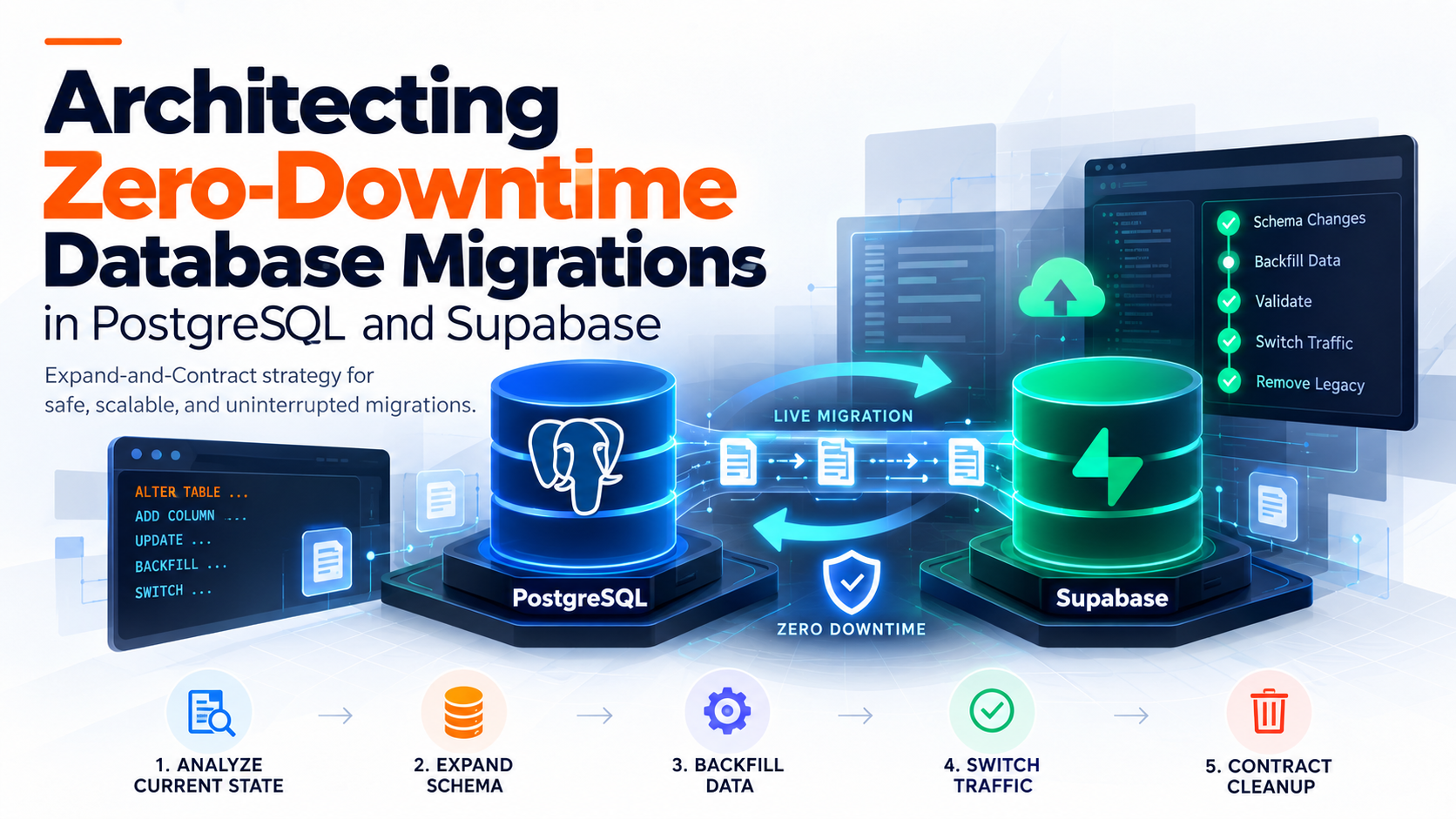
Architecting Zero-Downtime Database Migrations in PostgreSQL and Supabase
Large-scale database migrations often trigger service-halting locks. By adopting the Expand-and-Contract pattern, engineers can decouple schema changes from application logic.
GA
Gaurav Rahate
Principal Systems Architect
Executive Direct Answer
Zero-downtime migrations are achieved by decoupling schema changes from application updates. Instead of performing destructive DDL operations that trigger AccessExclusiveLocks, engineers must implement an 'Expand-and-Contract' pipeline. This involves creating new structures, dual-writing data, backfilling legacy records, and finally deprecating old columns. This approach ensures that the database remains available and performant throughout the transition, preventing the lock contention and service degradation typically associated with standard migration workflows in PostgreSQL and Supabase environments.
Key Takeaways & Core Principles
Avoid AccessExclusiveLocks by breaking DDL operations into non-blocking, additive steps.
Continue Reading
Related Research & Insights
Explore more architecture briefs, systems guides, and enterprise reports.
Dental clinics often lose patient volume due to missed calls and manual scheduling. Implementing an AI-driven receptionist system automates intake and reduces no-shows.
Bi-weekly strategic research on AI automation, CRM architectures, and modern digital engineering.
Implement dual-write application logic to maintain data consistency during the transition window.
Execute data backfills in controlled, throttled batches to prevent CPU and I/O saturation.
Ensure all migration phases are backward-compatible to facilitate rapid, safe rollbacks.
The Mechanics of Lock Contention in PostgreSQL
PostgreSQL manages concurrency through a sophisticated locking system. When performing DDL operations, such as ALTER TABLE, the database requires an AccessExclusiveLock. This lock is highly restrictive; it blocks all other access, including SELECT, INSERT, UPDATE, and DELETE queries. In high-traffic environments, a long-running DDL operation creates a queue of incoming requests, leading to connection exhaustion and service degradation.
Metadata-only changes, such as adding a nullable column, are generally fast. However, operations that require a full table rewrite—like changing a column type or adding a column with a non-constant default value—can hold locks for extended periods. Understanding the difference between these operations is critical for maintaining availability.
The Five-Phase Expand-and-Contract Migration Pipeline
To mitigate lock contention, we employ a sequential pipeline that separates schema modification from data migration:
Expand (Schema): Add the new column or table as nullable. This is a metadata-only operation and is safe to execute.
Dual-Write: Update the application layer to write to both the old and new structures. Reads continue to target the old structure.
Backfill: Run a background process to migrate existing data from the old structure to the new one in small, throttled batches.
Switch: Update the application logic to read exclusively from the new structure.
Contract: Once data integrity is verified, drop the old column or table structure.
Managing State and Data Consistency During Transitions
Maintaining synchronization during the backfill process is the most complex phase. If the application is actively writing to the database, the backfill process must account for concurrent updates. Using database triggers can automate this synchronization, ensuring that any write to the old column is immediately mirrored to the new one. Alternatively, application-level event handlers can manage this state. It is essential to monitor transaction isolation levels to prevent data drift during the transition, ensuring that the new structure eventually reaches a state of parity with the old.
Operational Trade-offs and Performance Considerations
| Consideration | Impact |
| :--- | :--- |
| Code Complexity | Increased due to dual-write and conditional logic. |
| Storage Overhead | Temporary increase as both structures coexist. |
| Latency | Potential minor spikes during background backfill jobs. |
While this pattern increases the operational surface area, it provides a predictable path for schema evolution without the risk of downtime. The primary trade-off is the requirement for more robust application-level handling of database state.
Error Handling and Rollback Strategies
Migrations must be idempotent. If a backfill job fails, it should be capable of resuming without duplicating data or causing inconsistencies. By maintaining backward compatibility in the application layer, teams can revert to the old schema structure instantly if the new implementation exhibits unexpected behavior. Monitoring tools should be configured to track lock wait times and transaction duration, providing early warnings if a migration phase begins to impact production performance.
Standard DDL commands often require an AccessExclusiveLock, which blocks all read and write operations on the table until the command completes, leading to request queuing and service timeouts.
About the Author
GR
Gaurav Rahate
Principal Systems Architect
Lead architect specializing in resilient enterprise platforms and cloud modernization.
Manual administrative tasks drain clinical resources. Learn how to architect secure, AI-driven automation workflows to synchronize data and reduce operational overhead.
RAHATE Enterprises helps businesses move from disconnected digital tools and manual processes towards structured, connected systems using AI automation, CRM, custom software, websites and digital marketing.
Whether you need intelligent AI automation, an integrated CRM architecture, or custom enterprise software, RAHATE Enterprises engineers unified infrastructure tailored to your exact operational workflows.